
What Are Peptides? A Simple Beginner’s Guide
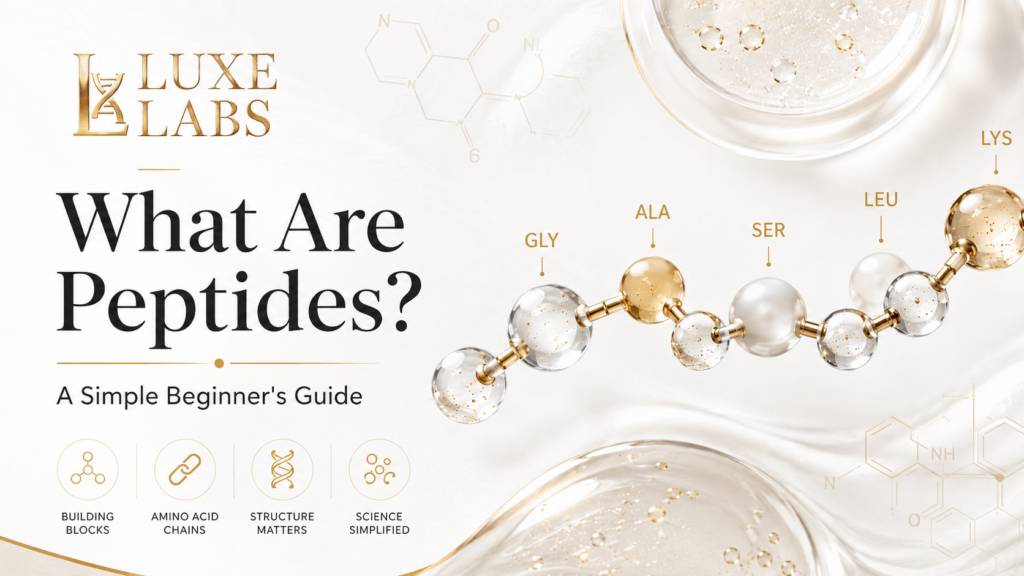
Peptides are short chains of amino acids, often described as smaller building blocks related to proteins. In simple terms, amino acids connect together through peptide bonds, creating structures that play important roles in biological research.
At Luxelabs, we believe education should come before hype. Peptides are often discussed in areas like skincare, fitness research, wellness trends, and laboratory studies, but it is important to understand that not every peptide is the same. Different peptide types may be studied for different purposes, and quality, handling, and responsible information matter.
A common misunderstanding is that “peptides” are one single thing. In reality, peptide science is broad. Some peptides naturally exist in the body, while others are synthesized for research or product development. Because of this, readers should always look for clear labeling, transparent information, and responsible brand communication.
Luxelabs focuses on clean, educational, and research-aware peptide content so customers can better understand the category without exaggerated promises.
Disclaimer: This article is for educational purposes only and is not medical advice.
Peptides are short chains of amino acids. Amino acids are often described as the basic building blocks of biology, and when a small number of them link together through what’s known as a peptide bond, the resulting structure is called a peptide.
Think of amino acids as individual beads on a string. String a few beads together, and you get a peptide. String together many more beads in a longer, folded structure, and you’re looking at something closer to a protein (more on that distinction below).
Peptides can range from just two amino acids to several dozen. Once a chain gets long enough and complex enough, scientists generally start classifying it as a protein instead. There’s no single rigid cutoff, but the general idea is: peptides are smaller, proteins are larger.
Where Do Peptides Come From?
Peptides aren’t all made the same way or for the same purpose. Broadly speaking, they fall into two categories:
- Naturally occurring peptides — these exist within biological systems and are part of the body’s own molecular makeup.
- Synthesized peptides — these are produced in laboratory settings, often for research purposes or use in formulated products like skincare.
This distinction matters because it’s one of the most common sources of confusion for beginners. Not every peptide is sourced or produced the same way, and understanding this helps explain why the peptide category can feel so broad.
Why Are Peptides Talked About So Much Right Now?
Peptides sit at the intersection of a few very active spaces:
- Skincare and cosmetic science — where peptides are frequently discussed as signaling ingredients in formulation research.
- Fitness and wellness communities — where peptides come up often in general conversation and trend discussions.
- Laboratory and academic research — where peptides continue to be an active area of scientific study.
Because peptides intersect all of these spaces at once, the term gets used a lot — sometimes accurately, sometimes loosely. That’s part of why beginner education matters so much in this category.
A Common Misunderstanding: “Peptides” Are Not One Single Thing
One of the biggest myths beginners run into is the idea that all peptides are interchangeable — that if you understand one, you understand them all. In reality, peptide science is broad and varied.
Different peptides have different structures, different origins, and different areas of research interest. Some are discussed in the context of skincare formulation. Others show up in broader biotechnology or research conversations. Because of this variety, it’s a mistake to treat “peptide” as a single, uniform category.
This is exactly why responsible brands emphasize clear labeling, transparent sourcing, and specific information rather than vague, catch-all marketing language.
Why Education Matters More Than Hype
The peptide space has grown quickly, and with rapid growth comes a lot of noise — bold claims, vague promises, and marketing language that outpaces the actual science.
At Luxelabs, we believe education should always come before hype. That means:
- Explaining concepts clearly instead of leaning on buzzwords
- Being upfront about what is and isn’t known
- Avoiding language that implies guaranteed outcomes
- Encouraging readers to look for transparency in any brand they consider
A well-informed reader is in a much better position to evaluate products, claims, and information critically — and that benefits everyone in the long run.
Add a review
Your email address will not be published. Required fields are marked *